
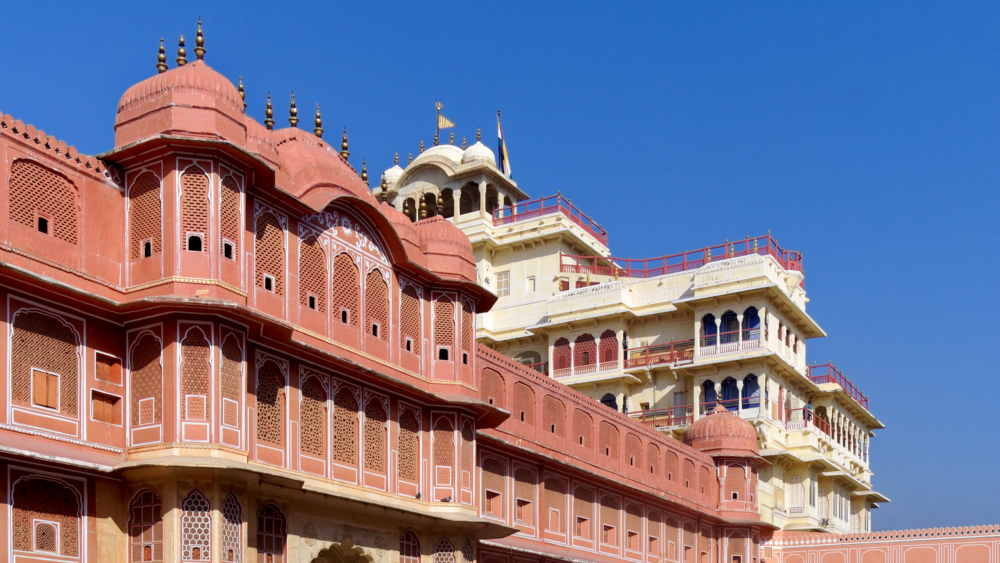
Stepping into the gates of the Jaipur City Palace is like entering a living‐canvas of royal Rajasthan: from the majestic courtyards and art-filled galleries to the still-inhabited royal residence, this palace complex offers a rich blend of history, architecture and culture. Located in the heart of Jaipur, Rajasthan (India), it was founded in 1727 by Maharaja Sawai Jai Singh II as part of his new city project.

Whether you’re a domestic traveller or visiting from abroad, on a budget or mid-range, this guide will walk you through everything you need to know — including Jaipur City Palace timings, ticket price, architecture, history, how to reach, museum highlights, photography rules, and more. Let’s begin!
Quick Snapshot
| Feature | Details |
|---|---|
| Location | Tulsi Marg, Gangori Bazaar, J.D.A. Market, Pink City, Jaipur, Rajasthan 302002. |
| Entry Fee* | Indian adults ~ ₹300 (museum & exterior) – children (7-12) ~ ₹150; foreigners adult ~ ₹1000 (validated 2025) |
| Timings | Day visit: ~ 9 : 30 AM – 5 : 00 PM/5 : 30 PM |
| Best Time to Visit | October – March (cooler weather) |
| Highlights | Mubarak Mahal, Chandra Mahal, courtyards, museum galleries, royal artefacts, fusion architecture |
| Photography & Rules | Photography allowed in many areas; certain zones have restrictions (e.g., private royal rooms) |
*Fees as of latest verified sources; subject to change (see “How I validated the facts” below).
Overview & History of Jaipur City Palace
The City Palace in Jaipur came into being as part of a grand vision. In 1727, Maharaja Sawai Jai Singh II shifted his capital from Amer to Jaipur, in part because of increasing population and declining water supply at Amer.The construction of the palace complex began soon after, with major works completed by around 1732.
Over the decades and centuries, successive rulers of the Kachwaha dynasty added wings, courtyards and elements to the complex. Today the palace remains partially a royal residence and partially a museum run by the Maharaja Sawai Man Singh II Museum Trust.
It is this layering of eras that makes the palace so special: you walk through 18th-century reception halls, 19th-century galleries, 20th-century additions — all set within the “Pink City” of Jaipur.
Architecture & Layout
The architecture of the City Palace is a beautiful fusion of Rajput, Mughal, and some European influences — reflecting the openness and adaptability of Jaipur’s royal court.
Key sections & buildings
- Mubarak Mahal: The “Welcome Palace”, built in the late 19th century by Maharaja Madho Singh II. It features Indo‐Saracenic architecture and today houses textiles and artefacts.
- Chandra Mahal: The seven-storey “Moon Palace”, still partially residence of the royal family. Each floor has its own name and story (e.g., Sukh Niwas, Shobha Niwas, Chhavi Niwas, etc.).
- Courtyards: The palace has multiple courtyards — the main ones are Udai Pol, Virendra Pol, Tripolia Gate (entrance) and the inner courtyards like Pritam Niwas Chowk with its seasonal gates.
- Museums & Galleries: Many wings are now museum galleries, with royal arms, textiles, art and photographs displayed.
This layout allows for a layered experience: begin at a grand gate, progress through courtyards, walk into halls, explore galleries and then perhaps glimpse private apartments (if part of a special tour).
Main Attractions
Below are the major attractions within the City Palace complex. Each is worth focusing on for your visit.
Mubarak Mahal (Textile & Royal Collection)
Once a reception hall, today this building holds a rich display of textiles, royal garments, shawls and carpets. The architecture itself — ornamental arches, balconies and jali‐work — is beautiful and photogenic.
Chandra Mahal (Royal Residence)
The seven-storey Chandra Mahal still serves as the residence of Jaipur’s royal family. Visitors can access certain floors via the paid “Royal Tour”. On the upper floors you’ll find rooms like Rang Mandir (Mirror Room), Shobha Niwas (Hall of Beauty) and the crown-floor. Because this segment is still private, access may be limited on the day of your visit.
Museum Galleries (Maharaja Sawai Man Singh II Museum)
This museum covers multiple galleries: arms and armour, textiles, paintings, photography archive of the royal family, and a transport gallery. You’ll see some of the largest silver urns in the world in the Diwan-e-Khas hall (for example) and a vast collection of royal carriages.
Pritam Niwas Chowk & Seasonal Gates

One of the most Instagram-worthy spots in the palace, Pritam Niwas Chowk has four richly decorated gates each representing a season (Peacock Gate, Lotus Gate, etc.).
Diwan-e-Khas & Diwan-e-Aam
The royal audience halls: Diwan-e-Aam (public audience) with marble pillars and painted ceilings; Diwan-e-Khas (private audience) with opulent interiors, where the royal throne (Takht-e-Rawal) is placed.
Light & Sound Show
The palace complex also offers a night experience: a “Museum at Night” and light & sound show. According to the official museum website, the “Museum at Night” ticket includes the Light & Sound Show.
- Opening hours: for night museum: 7:00 PM – 7:30 PM (ticket window opens at 6:30 PM) as per official site.
- Price (Indian adult): ₹500 (youth concession ₹250) for Museum at Night.
- Languages: While official site doesn’t list language options, many visitors indicate English & Hindi versions. (Night show details are less clearly published; we recommend checking on arrival or booking site.)
- Booking: Tickets may be available on the official site or at the palace counter. Verify current status if you are planning to attend the night show.
Note: If you cannot verify specific timing or show language, arrive at the palace around 6:30 PM and ask the ticket desk. (We found the most recent clear timing via the museum website.)
How to Reach
Getting to the City Palace in Jaipur is straightforward since it’s located in the city centre (Pink City).
- By Air: Jaipur International Airport (JAI) is about 13 km from the City Palace. Use a taxi/ride-hailing service.
- By Rail: Jaipur Junction Railway Station is about 5 km from the palace. Then you can take an auto-rickshaw or taxi.
- By Road / Within city: The palace is in Old Jaipur (Pink City) near Gangori Bazaar, Tripolia Gate etc. Autos, cycle-rickshaws, ride-hailing as well as local buses can get you there. Some attractions nearby make this area heavy on traffic, so allow extra time.
- Parking: According to the official museum website, parking is available only at Gate Number 2, near Jaleb Chowk.
- Metro: The nearest metro station is Badi Chaupar on the Pink Line.
Tip: Staying in or near the old city makes walking to the palace easy and lets you enjoy local bazaars around it.
Entry Fees & Timings
Here is a table summarising current entry fees and timings (validated as of late 2025). Always check on the palace’s official ticket site on the day of your visit, as fees may change.
| Visitor Category | Day Visit (Museum & Exterior) | Night Visit (“Museum at Night” incl. Light & Sound) |
|---|---|---|
| Indian Adult | ~ ₹300 (museum + exterior) | ~ ₹500 |
| Indian Child (7-12 yrs) | ~ ₹150 | ~ ₹250 |
| Foreign Adult | ~ ₹1000 | ~ ₹600 (source says nights for foreigner child: ₹300, adult unspecified) |
| Foreign Child (7-12 yrs) | ~ ₹650 composite ticket for both sections | ~ ₹300 |
Timings (Day Visit): Open from approx 9 : 30 AM to 5 : 00-5 : 30 PM daily.
Timings (Night): 7 : 00 PM to 7 : 30 PM (ticket window opens 6:30PM) for the night museum.
Important: Some sources report slightly different fees or timings — for example, one source lists ₹200 for Indians and ₹700 for foreign tourists. If you find such variations on the day of visit, follow the palace’s own ticket counter / website.
Museum Highlights
The palace museum (Maharaja Sawai Man Singh II Museum Trust) is a highlight in itself. Some of the key collections and galleries:
- Textile Gallery (in Mubarak Mahal): Displays royal garments, shawls, carpets, rich fabrics collected over generations.
- Painting & Photography Gallery: Contains 18th- and 19th-century paintings, rare photographs of royalty, and a collection of early cameras from Maharaja Sawai Ram Singh II.
- Arms & Armour (Sileh-Khāna): A rich display of weapons used by the royal family, including swords, muskets, armour, etc.
- Transport Gallery: Includes royal carriages, palanquins, and vehicular artifacts gifted to the Maharajas (one of which was from Queen Victoria).
- Special Tours (Royal Tour / Chandra Mahal upper floors): If you opt for the paid “Royal Tour”, you can access floors of Chandra Mahal with scenic city views and exclusive interiors. Official fee: Indian adult ₹4000, Youth ₹2000 for Royal Tour.
Visiting the museum gives context to the palace’s architecture and how the royal lifestyle evolved. Allocate ~1–2 hours extra if you want to explore deeply.
Photography & Dress Code Guidelines

Photography Rules
- In many areas, you can take photos.
- However, certain private royal rooms (especially in Chandra Mahal) restrict photography entirely.
- Tripods, flash photography and blocking public pathways are discouraged or prohibited.
- If you plan professional photography (pre-wedding shots, shoots) it’s best to check with the palace administration and obtain required permits.
Dress Code & Etiquette
- There is no extremely strict formal dress code, but visitors are advised to dress modestly, especially when visiting temple areas inside the complex.
- Comfortable footwear is strongly recommended — you’ll walk across courtyards, ramps and galleries.
- Respect signs and staff instructions — some sections might be off-limits if a royal event is ongoing.
- Carry water, especially in warmer months; smoking is not allowed inside the palace.
Nearby Attractions
When you’re visiting Jaipur City Palace, you may wish to combine your trip with the following nearby sites:
- Hawa Mahal – The “Palace of Winds”; about 0.5 km away.
- Jantar Mantar – The astronomical observatory built by the same Maharaja; approx 0.3 km away.
- Albert Hall Museum – Located roughly 2–3 km away; perfect for an afternoon or evening stop.
Including these in your day allows you to make the most of exploring the old city (Pink City) of Jaipur.
Travel Tips
- Arrive early (around 9:30 AM) to beat the crowds and enjoy cooler morning light.
- Best time of year: October to March – when weather is pleasant and less dusty.
- Plan for at least 2-3 hours inside the palace museum + galleries. Some sources suggest even 3 hours if you include Royal Tour and photo-stops.
- Book tickets online in advance if possible, especially for busy seasons or ‘Royal Tour’.
- For the light & sound show, confirm the schedule ahead of time (ticket counters open 6:30 PM).
- Wear comfortable shoes, carry water, hat/sunglasses if visiting midday summer.
- Stay hydrated and rest inside shaded courtyards — the palace grounds are extensive.
- Ask for audio guides or authorised guides in your language if you want richer context.
- Avoid carrying large backpacks, drones, or tripod setups unless permitted.
- Check for any vehicle restrictions in the old city on festival days (e.g., during the Teej festival the area around City Palace had vehicle restrictions).
Suggested Itinerary
Half-Day Plan (Ideal if you have limited time)
- Arrive by 9:30 AM
- Enter via Virendra Pol or Udai Pol, explore courtyards and Mubarak Mahal (Textile Gallery)
- Move to Pritam Niwas Chowk (season-gates photo stop)
- Visit Museum Galleries (Arms & Armour, Painting & Photography)
- Exit by ~12:30 PM and head to nearby Hawa Mahal or a café in the old city for lunch
Full-Day Plan (For a relaxed experience)
- 9:30 AM – Enter City Palace
- 9:30-11:00 – Explore courtyards, Mubarak Mahal, Pritam Niwas
- 11:00-12:30 – Museum Galleries
- 12:30-1:30 – Lunch in nearby market/heritage restaurant
- 1:30-3:00 – Chandra Mahal view, rooftop or upper floor if Royal Tour booked
- 3:00-4:30 – Stroll old city markets (Johari Bazaar, Tripolia Bazaar)
- 4:30–5:30 – Exit via palace and catch sunset photos; optionally return around 6:30 PM for night museum/light-&-sound show
Food & Shopping Near City Palace
Food:
- Look for heritage cafés and Rajasthani thali restaurants around the old city. After your palace visit, stop by a rooftop café overlooking the palace or the bazaars for local snacks.
- Try local dishes: dal baati churma, gatte ki sabzi, Rajasthan’s thali, kachori and sweets like ghewar or mawa kachori.
Shopping:
- Johari Bazaar (jewellery, gemstones)
- Tripolia Bazaar (textiles, bangles, handicrafts)
- Right around the palace you’ll find stalls and small shops selling miniatures, textiles, carpets, souvenirs.
Make sure to bargain politely and check quality (especially for textiles).
Safety & Responsible Tourism
- For women travellers: Jaipur is generally safe, but as in any city, stay alert in crowds, avoid isolated lanes at night, and dress respectfully (especially in heritage sites).
- Sustainability tip: Carry a refillable water bottle (water stations available inside palace). Avoid littering in heritage zones; the palace complex emphasises accessibility and respectful tourism.
- Respect the heritage: Do not climb on railings or artefacts, follow signage, respect “no-photography” areas.
- When using local transport (autos, ride-hailing), confirm fare or use apps to avoid over-paying.
- If visiting with children, supervise them in the courtyards and galleries as some sections may have stairs or uneven surfaces.
- Check for crowd/days when royal events may restrict access to certain wings (e.g., Chandra Mahal floors).
Top FAQs
Here are some frequently asked questions about the Jaipur City Palace.
Q1: What are the exact opening hours of Jaipur City Palace?
A1: Typically 9 : 30 AM to around 5 :00-5 :30 PM for the day visit. Night museum/light-&-sound show tickets begin around 6 : 30 PM, with show around 7 : 00 PM.
Q2: How much do tickets cost for domestic vs foreign visitors?
A2: For Indian nationals day visit museum & exterior ~ ₹300 adult, ~₹150 for children (7-12 yrs) per official museum site. For foreign adult ~ ₹1000 as per latest data. Night museum adult Indian ~ ₹500, youth ~ ₹250.
Q3: Can I take photographs inside the palace?
A3: Yes, in many public courtyards and galleries photography is allowed, but in some private royal apartments or where with “no photography” signage you must refrain. Tripods/flash may be restricted.
Q4: What is the best time of year/day to visit?
A4: The best months are October to March when the weather in Jaipur is cool and pleasant. For the day, arriving early (9:30 AM) helps avoid peak heat and crowds.
Q5: How do I reach Jaipur City Palace from the airport/railway station?
A5: Jaipur International Airport is ~13 km away and Jaipur Junction railway station is ~5 km away. You can hire a taxi or use ride-hailing. The palace is located in the old city, accessible via auto-rickshaw, cycle rickshaw or metro (Badi Chaupar).
Q6: Are guided tours available inside the palace?
A6: Yes — official guides and audio guides are available. The “Royal Tour” (upper floors of Chandra Mahal) is a premium option.
Q7: Is it wheelchair accessible?
A7: According to the official site: yes, ramps and golf-cart options exist for those with limited mobility.
Conclusion
The Jaipur City Palace is a jewel in the heart of Jaipur, combining regal history, architectural beauty, museum treasures and a living connection with the royal family. Whether you have a few hours or a full day, this palace warrants your time. Arrive early, walk its courtyards, admire the craftsmanship, and respect its heritage. Travel thoughtfully, enjoy the stories the walls tell, and leave with memories of the “Pink City” that stay long after your visit.
Read more: Attractions

.jpg)
