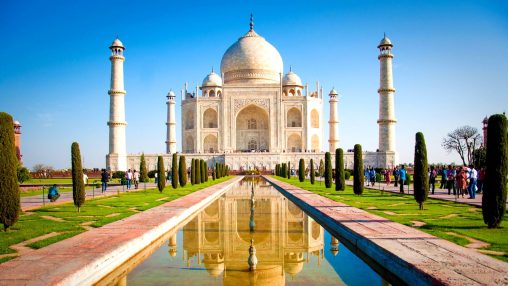
Did you know that the Taj Mahal attracts over 5 million visitors every year? This iconic monument is not just a marvel of architecture but also a symbol of eternal love. Located at 27°10′30″N 78°2′31″E, it stands proudly on the banks of the Yamuna River in the historic city of Agra.

Built between 1631 and 1653, the Taj Mahal was commissioned by Emperor Shah Jahan in memory of his beloved wife, Mumtaz Mahal. Over 20,000 workers from across continents contributed to its construction, making it a true global effort. Recognized as a UNESCO World Heritage Site since 1983, it remains one of the most visited landmarks in the world.
Today, the monument’s original cost of ₹32 million is equivalent to a staggering $827 million. Its timeless beauty and historical significance continue to captivate visitors from all corners of the globe.
Key Takeaways
- The Taj Mahal is a UNESCO World Heritage Site and one of India’s most iconic landmarks.
- It attracts over 5 million visitors annually, making it a global tourist hotspot.
- Located at 27°10′30″N 78°2′31″E, it sits on the banks of the Yamuna River in Agra.
- Built over 22 years, it involved 20,000 workers from multiple continents.
- The monument symbolizes the eternal love between Emperor Shah Jahan and Mumtaz Mahal.
- Its original construction cost of ₹32 million equals $827 million today.
Introduction to the Taj Mahal Agra
Commissioned by a grieving emperor, the Taj Mahal stands as a testament to love. The Mughal Emperor Shah Jahan ordered its construction in 1631 after the death of his beloved wife, Mumtaz Mahal. She passed away during the birth of their 14th child, leaving the emperor heartbroken.
The complex spans 42 acres, featuring a mosque, a guest house, and meticulously designed formal gardens. Its layout reflects a perfect blend of Persian, Islamic, and Indian architectural traditions. This fusion creates a harmonious and timeless design.
Mumtaz Mahal was interred in the mausoleum in 1643, while Shah Jahan was buried beside her in 1666. Their tombs lie at the heart of the complex, symbolizing their eternal bond. Today, the Archaeological Survey of India manages this iconic site, ensuring its preservation for future generations.
The Taj Mahal is more than just a monument; it’s a story of love, loss, and legacy. Its grandeur continues to inspire millions, making it a must-visit destination for travelers worldwide.
The History Behind the Taj Mahal
Behind the grandeur of the Taj Mahal lies a tale of passion and perseverance. This iconic monument is not just a marvel of architecture but also a symbol of an extraordinary love story. Its creation is intertwined with the lives of Shah Jahan and Mumtaz Mahal, whose bond inspired one of the world’s most beautiful structures.
The Love Story of Shah Jahan and Mumtaz Mahal
Shah Jahan, the Mughal emperor, was deeply devoted to his wife, Mumtaz Mahal. Their love story began when they married in 1612, and she became his trusted companion. Sadly, Mumtaz passed away in 1631 while giving birth to their 14th child. On her deathbed, she made a final request: to build a magnificent tomb in her memory.
Devastated by her loss, Shah Jahan vowed to fulfill her wish. He envisioned a structure that would immortalize their love and stand the test of time. This promise led to the creation of the Taj Mahal, a masterpiece that continues to inspire millions.
The Construction of the Taj Mahal
The construction of the Taj Mahal began in 1632 and took 22 years to complete. Under the guidance of architect Ustad Ahmad Lahori, over 20,000 workers and 1,000 elephants were employed. The materials, including Makrana marble, were transported over 240 miles via elephant caravans.
Workers were housed in a nearby township called Mumtazabad, ensuring they had accommodations during the long years of construction. The first anniversary ceremony was held in 1643, marking a significant milestone in the project.
After its completion, Shah Jahan spent his final years under house arrest in Agra Fort, where he could gaze at the Taj Mahal. His tomb was later placed beside Mumtaz’s, symbolizing their eternal bond.
Architectural Marvel of the Taj Mahal
The architectural brilliance of this iconic structure is a testament to human ingenuity. Its design seamlessly blends Persian, Islamic, and Indian influences, creating a masterpiece that stands the test of time. Every detail, from the grand dome to the intricate carvings, reflects the pinnacle of Mughal architecture.
Design and Layout of the Taj Mahal Complex
The complex is a perfect example of geometric symmetry. The main building is flanked by a mosque and a guest house, both constructed with red sandstone to contrast the pristine white marble of the mausoleum. This deliberate use of materials symbolizes the balance between earthly and divine elements.
One of the most striking features is the main dome, which rises to a height of 73 meters. Its double-shell construction not only enhances its grandeur but also creates unique acoustic effects. The minarets, designed to tilt slightly outward, serve both aesthetic and practical purposes, offering protection against earthquakes.
The Use of White Marble and Red Sandstone
The white marble used in the mausoleum was sourced from Makrana, Rajasthan, and is adorned with intricate inlay work. This technique, known as pietra dura, involves embedding 28 types of semi-precious stones into the marble. The result is a stunning display of floral and geometric patterns.
In contrast, the red sandstone structures add warmth and depth to the complex. This material was commonly used in Mughal architecture for its durability and vibrant color. Together, these materials create a visual harmony that enhances the overall beauty of the structure.
Optical illusions are another fascinating aspect of the design. The calligraphy on the walls increases in size as it moves upward, ensuring it appears uniform from the ground. This attention to detail showcases the unparalleled craftsmanship of the artisans involved.
The Gardens of the Taj Mahal
Step into a world of symmetry and beauty with the gardens of this historic site. The garden is not just a decorative feature but a carefully planned design that reflects Islamic concepts of paradise. Known as the Charbagh, it symbolizes the four rivers of heaven described in the Quran.
The layout is divided into 16 sunken parterres, each filled with vibrant flowers like roses and daffodils. A sophisticated water system, using copper pipes and animal-powered pumps, ensures the garden remains lush and green. This hydraulic engineering was ahead of its time and remains a marvel today.
The Charbagh Garden Design
The Charbagh design is a perfect example of geometric harmony. It represents the Islamic idea of paradise, with four rivers flowing through it. The garden’s symmetry aligns with the main structure, creating a sense of balance and tranquility.
During the British era, the original orchards were replaced with English-style lawns. This change altered the garden’s appearance but not its spiritual significance. Today, efforts are made to preserve its historical elements while maintaining its beauty.
The Reflecting Pool and Its Significance
At the heart of the garden lies the reflecting pool, a key feature of the design. This central water body mirrors the monument perfectly, especially during sunrise. The reflection creates a stunning visual effect, enhancing the site’s ethereal beauty.
Across the Yamuna river, the Mahtab Bagh, or moonlight garden, offers another perspective. Designed to complement the main garden, it provides a serene escape under the night sky. Together, these gardens form an integral part of this world heritage site, blending nature and architecture seamlessly.
The Interior of the Taj Mahal
The interior of this iconic monument reveals a world of artistry and symbolism. Beyond its breathtaking exterior lies a space filled with intricate designs and historical significance. Every corner tells a story, blending beauty with purpose.
The Cenotaphs of Mumtaz Mahal and Shah Jahan
The upper chamber houses the false cenotaphs of Mumtaz Mahal and Shah Jahan. These ornate structures are adorned with Quranic calligraphy and floral motifs. The use of precious stones like lapis lazuli and carnelian adds to their grandeur.
Below lies the actual burial chamber, where the tombs are simpler yet deeply symbolic. The 99 Names of Allah are inscribed here, reflecting the spiritual essence of the site. A marble jali screen, replacing the original gold one in 1643, surrounds the graves.
Intricate Inlay Work and Decorative Elements
The interior is a masterpiece of pietra dura, a technique that embeds semi-precious stones into marble. Floral patterns, using Persian turquoise and Yemeni lapis, cover the walls. These designs symbolize paradise and eternal beauty.
Gender markers are subtly incorporated into the design. A pen box on Shah Jahan’s sarcophagus signifies his role as a ruler. This attention to detail highlights the craftsmanship of the artisans.
| Feature | Upper Chamber | Lower Chamber |
|---|---|---|
| Design | Ornate cenotaphs with Quranic calligraphy | Simple tombs with inscriptions |
| Materials | Lapis lazuli, carnelian, marble | Marble with 99 Names of Allah |
| Symbolism | Representation of eternal love | Spiritual connection to Allah |
The Mosque and Guest House
Flanking the main structure, these buildings serve both purpose and beauty. Positioned on either side of the mausoleum, they enhance the complex’s symmetry and functionality. The west building is a functional mosque, while the east structure, known as the jawāb, mirrors its design perfectly.
Both buildings are constructed with red Sikri sandstone, adding warmth to the pristine white marble of the main structure. Their matching dimensions—21.3 meters in length and 7.6 meters in width—ensure a balanced appearance. This uniformity reflects the Mughal emphasis on geometric harmony.
Architectural Symmetry and Functionality
The presence of a mosque in Mughal mausoleums was mandatory, serving as a place for prayer and reflection. The west building fulfills this role, with its interior designed to enhance the prayer experience. The acoustics amplify the recitation of Quranic verses, creating a serene atmosphere.
The east building, though not a functional mosque, maintains perfect symmetry. Today, it serves as a museum and store, offering visitors insights into the history and craftsmanship of the complex. Every decorative element, from the arches to the inlay work, mirrors the west building precisely.
| Feature | West Building (Mosque) | East Building (Jawāb) |
|---|---|---|
| Material | Red Sikri sandstone | Red Sikri sandstone |
| Function | Place of prayer | Museum and store |
| Dimensions | 21.3m x 7.6m | 21.3m x 7.6m |
The Minarets of the Taj Mahal
Standing tall and elegant, the minarets of this iconic monument are a marvel of engineering and design. These four towers, each reaching a height of 40 meters, frame the main structure perfectly. They are not just decorative but also serve practical purposes, showcasing the brilliance of Mughal architecture.
Design and Symbolism of the Minarets
Each minaret is divided into three sections, topped with a dome-shaped finial. This design adds to their aesthetic appeal while maintaining structural integrity. Interestingly, the minarets are tilted outward at a 2° angle. This unique feature protects the main tomb in case of an earthquake, ensuring the building remains safe for centuries.
Though primarily decorative, the minarets also have a functional aspect. They were designed to resemble traditional Islamic towers used by muezzins to call for prayer. Inside, narrow staircases lead to the top balconies, offering breathtaking views of the surrounding area.
Over the years, the minarets have undergone restoration to preserve their beauty. In 2018, the finials were carefully restored to their original glory, ensuring the structure remains as stunning as ever.
| Feature | Details |
|---|---|
| Height | 40 meters |
| Sections | 3 per minaret |
| Tilt | 2° outward for earthquake protection |
| Function | Decorative and symbolic |
| Restoration | Finials restored in 2018 |
The Taj Mahal as a UNESCO World Heritage Site
In 1983, this architectural wonder earned a prestigious title that solidified its place in history. Designated as a UNESCO World Heritage Site, it was recognized for its exceptional cultural and artistic significance. This monument meets two key criteria: it is a creative masterpiece and a symbol of profound cultural heritage.
Criteria for UNESCO Recognition
The inscription process highlighted the site’s universal value. UNESCO acknowledged its architectural brilliance and its role as a symbol of eternal love. The complex’s design, blending Persian, Islamic, and Indian styles, was deemed a masterpiece of human creativity.
The Archaeological Survey of India (ASI) now oversees its preservation. Their efforts ensure this world heritage site remains intact for future generations. Challenges like air pollution, however, threaten its pristine white marble.
In 2007, the monument was voted one of the New7Wonders of the world, further cementing its global appeal. Despite its fame, night viewing was restricted from 1984 to 2004 to protect its delicate structure. Today, it continues to inspire millions, standing as a testament to love and artistry.
Tourist Tips for Visiting the Taj Mahal
Planning a trip to this iconic landmark? Here’s everything you need to know. From the best time to visit to navigating the city, these tips will ensure a smooth and memorable experience.

Best Time to Visit the Taj Mahal
The ideal time to explore this architectural wonder is between October and March. During these months, the weather is pleasant, making it easier to enjoy the site. Avoid the summer months, as temperatures can soar above 100°F.
The monument is open from sunrise to sunset, except on Fridays. For a unique experience, night viewing is allowed five days a month. The soft moonlight reflecting off the white marble creates a magical ambiance.
How to Get to the Taj Mahal
The nearest airport is just 7 kilometers away, making air travel a convenient option. If you’re coming from Delhi, the Yamuna Expressway offers a smooth and scenic drive. Public transport, including buses and trains, is also available for budget-conscious travelers.
Security protocols are strict, so be prepared. Prohibited items include food, large bags, and tripods. Light snacks and water bottles are allowed, but only in transparent containers.
- Combined Tickets: Consider purchasing a combined ticket that includes entry to the Agra Fort. This saves both time and money.
- Pricing: Foreign visitors pay ₹1000, while Indian citizens pay ₹50. This pricing structure has been in place for years.
With these tips, your visit to this historic site will be both enjoyable and hassle-free. Don’t forget to capture the beauty of the monument and its surroundings!
The Cultural Significance of the Taj Mahal
The cultural impact of this iconic monument extends far beyond its stunning architecture. It has become a powerful symbol of India’s rich history and a testament to the enduring legacy of the Mughal emperor who commissioned it. From its portrayal in films to its depiction on currency, the monument continues to inspire and captivate the world.
The Taj Mahal in Indian History
This monument holds a special place in India’s history. It was built during the Mughal era, a period marked by significant cultural and artistic achievements. The emperor Shah Jahan envisioned it as a tribute to his beloved wife, but over time, it has come to represent much more. Today, it is featured on the ₹1000 banknote, symbolizing national pride and heritage.
However, its history is not without controversy. In 2017, claims surfaced suggesting it was originally a Hindu temple. While these claims remain unproven, they highlight the monument’s role in ongoing discussions about India’s diverse cultural identity.
The Taj Mahal as a Symbol of Love
At its core, this monument is a symbol of eternal love. The story of Shah Jahan and Mumtaz Mahal has inspired countless interpretations, from Bollywood films to literary works. Its appearance in movies like Life of Pi underscores its universal appeal as a representation of devotion and beauty.
Beyond its romantic narrative, the monument also reflects Sufi influences in its design. The intricate carvings and calligraphy evoke spiritual themes, adding depth to its cultural significance. Whether viewed as a love story or a spiritual masterpiece, it continues to resonate with people across the world.
- Political Symbol: Used as a soft power tool to promote India’s cultural heritage globally.
- Beyond Romance: Interpreted as a symbol of unity and artistic achievement.
- Cultural Icon: Appears in films, literature, and even currency, cementing its place in popular culture.
Preservation Efforts for the Taj Mahal
Preserving this iconic monument has become a global priority. Over the centuries, environmental and human factors have posed significant challenges. Today, innovative techniques and strict measures are in place to protect its beauty and structural integrity.
Challenges in Maintaining the Taj Mahal
One of the biggest threats is air pollution. Particulate matter from nearby factories and vehicles has caused the pristine white marble to yellow. To combat this, a 10-kilometer buffer zone was established, and factories contributing to acid rain were closed.
Another issue is the aging structure. The wooden foundation, laid over three centuries ago, requires constant monitoring. The Archaeological Survey of India (ASI) uses advanced technology to ensure stability and prevent long-term damage.
Recent Restoration Projects
In 2018, a mudpack treatment was applied to the marble surface. This traditional method, using Fuller’s earth, helped remove stains and restore its original shine. In 2020, laser cleaning technology was introduced for more precise restoration.
Recent efforts include repairing cracks in the main dome in 2022. Plans are also underway to restore the original garden layout, bringing back its historic charm. These projects ensure the monument remains a symbol of love and artistry for future generations.
| Year | Restoration Project | Impact |
|---|---|---|
| 2018 | Mudpack Treatment | Removed stains, restored shine |
| 2020 | Laser Cleaning | Precise restoration of details |
| 2022 | Dome Crack Repair | Ensured structural stability |
The Taj Mahal in Popular Culture
The influence of this architectural wonder extends far beyond its physical presence. Over the centuries, it has inspired countless works of art, literature, and film, becoming a global cultural icon. Its timeless beauty and profound symbolism continue to captivate creators and audiences alike.
Literature and Film
This iconic structure has made its mark in literature and film. In Wilkie Collins’ 1868 novel The Moonstone, it is referenced as a symbol of mystery and grandeur. The monument also served as a backdrop in the Oscar-winning film Slumdog Millionaire, highlighting its cultural significance in modern storytelling.
Its design and architecture have inspired artists and writers for generations. Nobel laureate Rabindranath Tagore referenced it in his poetry, celebrating its beauty and emotional depth. The monument’s influence even extends to the world of fragrance, with the creation of the Taj perfume, inspired by its elegance.
Art and Music
Renowned sculptor Anish Kapoor has paid homage to this monument through his works, reflecting its geometric perfection. In music, Coldplay’s Hymn for the Weekend video features the monument, showcasing its global appeal.
Replica hotels in Dubai and Atlantic City further demonstrate its cultural impact. These structures mimic its architecture, allowing people worldwide to experience its grandeur. UNESCO’s studies on its cultural significance highlight its role as a symbol of unity and artistic achievement.
- Tagore’s Poetry: Celebrates its beauty and emotional resonance.
- Anish Kapoor’s Works: Reflect its geometric perfection.
- Coldplay’s Video: Features the monument as a global icon.
- Replica Hotels: Bring its grandeur to new audiences.
- UNESCO Studies: Analyze its cultural and artistic impact.
Interesting Facts About the Taj Mahal
Beyond its iconic beauty, the Taj Mahal holds secrets and stories that few know about. From hidden staircases to missing gemstones, this architectural marvel is full of surprises. Let’s uncover some of its lesser-known details.
Little-Known Details About the Taj Mahal
Did you know the original gold finial atop the dome was stolen during the British era? Chisel marks from removal attempts are still visible today. This theft is just one of the many mysteries surrounding the monument.
Another fascinating detail is the placement of Shah Jahan’s tomb. It is slightly off-center, a deliberate design choice that adds to the monument’s uniqueness. Hidden staircases leading to the river Yamuna were also discovered, showcasing the ingenuity of its construction.
During World War II, bamboo scaffolding was erected to protect the marble structure from potential bombings. In 2001, the monument faced another threat during the Ayodhya conflict, but it remained unharmed.
The Taj Mahal also features a sophisticated temperature control system. Water channels beneath the structure help regulate the interior climate, ensuring it remains cool even in scorching heat. However, some gemstones from the jali screens are missing, adding to its enigmatic charm.
| Feature | Details |
|---|---|
| Gold Finial | Stolen during British era, chisel marks remain |
| Shah Jahan’s Tomb | Placed slightly off-center |
| Hidden Staircases | Lead to the Yamuna River |
| Bamboo Scaffolding | Used in 1942 for protection |
| Temperature Control | Water channels beneath the structure |
| Missing Gemstones | From jali screens |
Conclusion
As a testament to human creativity and love, this UNESCO World Heritage Site continues to inspire millions. Its architecture stands as a pinnacle of Mughal achievement, blending Persian, Islamic, and Indian styles into a harmonious masterpiece. The complex, with its gardens, mosque, and guest house, reflects both beauty and purpose.
Preserving this iconic monument remains a priority. Efforts to combat pollution and restore its pristine marble ensure it endures for future generations. Visitors can enhance their experience by planning trips during cooler months and respecting guidelines to protect the site.
At its heart, the Taj Mahal tells a story of eternal love. Shah Jahan’s tribute to Mumtaz Mahal transcends time, reminding us of the power of devotion. By practicing responsible tourism, we can honor this legacy and ensure its beauty remains for centuries to come.
Read More: Attractions
FAQ
The best time to visit is during the cooler months from October to March. Early mornings or late afternoons offer the most pleasant weather and stunning views.
Construction took around 22 years, starting in 1632 and finishing in 1653. Thousands of artisans and laborers worked on this architectural masterpiece.
The structure primarily uses white marble, with accents of red sandstone. Precious and semi-precious stones were also used for intricate inlay work.
Mughal Emperor Shah Jahan built it as a mausoleum for his beloved wife, Mumtaz Mahal. Its creation was a testament to their deep love and devotion.
Yes, the complex includes a mosque, a guest house, and beautifully landscaped gardens. These structures complement the main mausoleum’s design.
The four minarets are not just decorative but also functional. They were designed to lean slightly outward to protect the main tomb in case of an earthquake.
Yes, visitors can explore the interior, which houses the cenotaphs of Mumtaz Mahal and Shah Jahan. The intricate carvings and inlay work are breathtaking.
It showcases key elements of Mughal design, such as symmetry, domes, and the use of white marble. The gardens and water features also reflect Persian influences.
Yes, it was designated a UNESCO World Heritage Site in 1983 for its cultural and architectural significance.
Pollution, weathering, and the impact of tourism pose significant challenges. Ongoing restoration projects aim to protect this iconic monument for future generations.