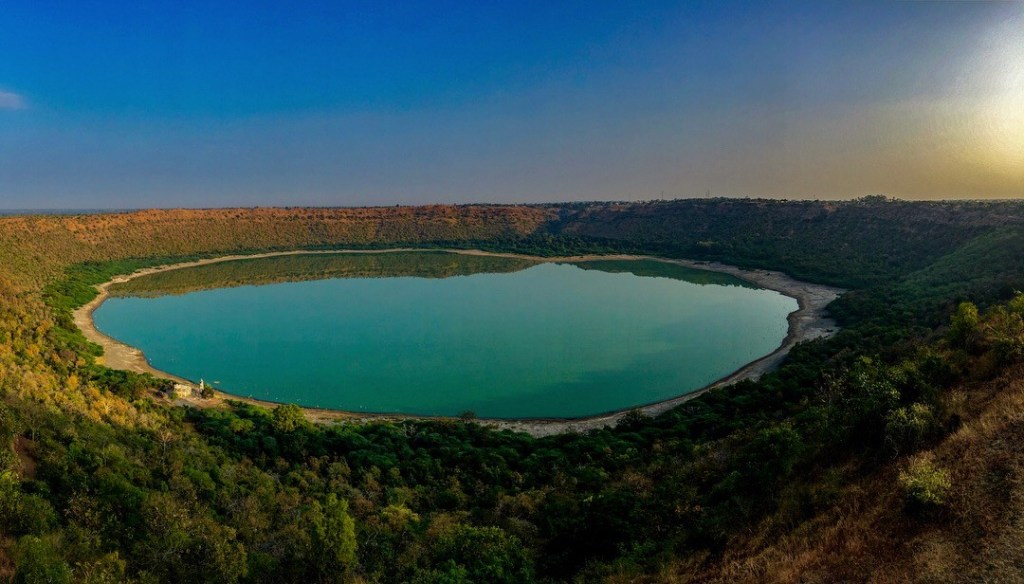
You are about to discover one of India’s most extraordinary natural wonders – a lake formed by a cosmic visitor that crashed into Earth thousands of years ago.
This impact created a perfect bowl-shaped depression filled with mysterious pink waters. The crater lake, a saline, soda lake, is a notified National Geo-heritage Monument.

The crater stands as the only known hypervelocity impact crater in basaltic rock in Asia, making it a geological marvel. In 2020, the world watched in amazement as the lake transformed from its usual greenish hue to a stunning pink color.
Key Takeaways
- The Lonar Crater is a unique natural wonder formed by a meteorite impact.
- It’s the only hypervelocity impact crater in basaltic rock in Asia.
- The lake‘s waters have a unique alkaline-saline composition.
- The water turned pink in 2020, attracting global attention.
- NASA scientists have compared the crater to lunar landscapes.
The Mysterious Pink Lake of Maharashtra
As you explore the wonders of Maharashtra, you’ll discover the enigmatic Lonar Lake, a body of water shrouded in mystery and scientific intrigue. Located in the Buldhana district, this lake is a significant landmark within the Lonar Crater, a massive impact crater formed by a meteorite.
A Natural Wonder in the Deccan Plateau
Lonar Lake is situated in the Deccan Plateau, a region known for its volcanic origins and unique geological formations. The lake is a natural wonder, attracting scientists and tourists who are drawn to its unusual characteristics and the crater’s historical significance. The surrounding landscape is dotted with ancient temples and diverse flora and fauna, making it a fascinating destination for those interested in nature and history.
The Unique Saline-Alkaline Waters
The water of Lonar Lake is renowned for its saline-alkaline properties, containing various salts and sodas. You’ll be intrigued to know that the lake’s water is approximately seven times saltier than seawater, creating a harsh environment that few organisms can tolerate. The lake maintains two distinct water zones that don’t mix: an outer neutral ring (pH7) and an inner highly alkaline core (pH11), each supporting unique ecosystems. Some key features of the lake include:
- The presence of two small streams, Purna and Penganga, that feed into the lake, alongside a freshwater well on its southern edge.
- A dual-nature water system that creates a natural laboratory for different ecosystems to thrive.
- The deposition of valuable soda and salt compounds during dry seasons, which have been harvested for commercial and medicinal purposes.
This unique environment makes Lonar Lake a subject of scientific study, particularly in understanding how life adapts to extreme conditions.
The Cosmic Origin of Lonar Crater
As you explore the depths of Lonar Crater, you’ll uncover the fascinating story of its cosmic origin. This natural wonder, located in the Deccan Plateau of India, has been a subject of interest for scientists and visitors alike due to its unique characteristics and mysterious past.
The Meteorite Impact Theory
The formation of Lonar Crater is attributed to a massive meteorite impact. Scientists believe that a large meteorite struck the Earth’s surface, creating the crater we see today. This theory is supported by various geological features observed within and around the crater. The impact would have released enormous energy, causing significant changes to the local geology.
Age and Formation Timeline
Understanding the age of Lonar Crater is crucial to placing it within Earth’s geological history. Initially, the crater’s age was estimated to be around 52,000 years. However, recent studies using advanced dating techniques like argon-argon analysis suggest that the crater is much older, approximately 570,000 to 576,000 years old. This revised age aligns better with the observed erosion patterns of the crater rim, indicating that it has been subjected to weathering for hundreds of thousands of years.
The crater’s formation represents a moment in geological time, yet it has persisted for over half a million years. This longevity is a testament to the dramatic forces that have shaped our planet. By understanding the true age of Lonar Crater, scientists can better compare it with other impact sites around the world, providing valuable insights into the Earth’s history.
- The age of Lonar Crater has been revised significantly, from 52,000 years to approximately 570,000 years, based on newer dating techniques.
- The impact is believed to have occurred around 570,000 to 576,000 years ago, during the middle Pleistocene epoch.
- This revised timeline is consistent with the erosion patterns observed on the crater rim.
Geological Features of Lonar Crater
As you explore the Lonar Crater, you’ll discover its unique geological features that set it apart from other natural wonders. The crater’s distinct characteristics make it a fascinating subject for geologists and tourists alike.
Crater Dimensions and Structure
The Lonar Crater is approximately 1.8 kilometers in diameter and 150 meters deep, with a crater rim that rises about 20 meters above the surrounding terrain. The crater’s dimensions and structure provide valuable insights into its formation and evolution over time.
The Five Distinct Zones of the Crater
Geologists have identified five distinct zones within the Lonar Crater, each with unique characteristics that tell part of the impact story. These zones are:
- The outermost ejecta blanket, consisting of material thrown outward during the impact.
- The crater rim, an elevated ridge marking the boundary of the impact site.
- The steep slopes of the crater, covered with vegetation that has colonized this challenging terrain.
- The crater basin floor, a relatively flat area between the slopes and the lake.
- The crater lake itself, with its unique chemical properties and microbial inhabitants.
These zones not only highlight the complexity of the crater’s features but also demonstrate the crater’s significance as a geological wonder.
The Pink Phenomenon: Why Lonar Lake Changes Color
The sudden change in Lonar Lake’s color to pink is not just a visual spectacle; it’s a result of intricate biological processes. As you delve into the mystery, you’ll find that the lake‘s color transitions are directly tied to the microscopic life thriving in its extreme saline alkaline environment.
The 2020 Color Transformation
In 2020, Lonar Lake astonished observers by turning pink, a phenomenon that sparked widespread interest. “The change was so striking that it caught the attention of both locals and scientists,” as quoted by a researcher. This event was not an isolated incident but part of a larger pattern of color changes observed in the lake.
Scientific Explanations Behind the Pink Hue
The water in Lonar Lake appears green for most of the year due to dense blooms of cyanobacteria, such as Arthrospira species. However, during periods of increased evaporation and saline conditions, the balance shifts to favor halophilic archaea and bacteria. These microorganisms produce pink-red carotenoid pigments as a protective mechanism against intense solar radiation.
The presence of diverse functional groups of microorganisms, including methanogens, methanotrophs, and sulfate reducers, contributes to the complex ecosystem of the lake. The dual pH zones within the lake create multiple microhabitats where different colored microorganisms can dominate, sometimes creating visible boundaries between differently colored water sections.
As you explore further, it becomes clear that the pink coloration is not just a simple change but a reflection of the intricate balance within the lake’s ecosystem.
Microbial Life in Extreme Conditions
The extreme environment of Lonar Crater makes it an ideal location for studying microbial life that can survive in similar conditions elsewhere in the universe. You are about to explore one of the most fascinating ecosystems on Earth, where life thrives in conditions that would be hostile to most known organisms.
Unique Microorganisms in the Lake
The saline-alkaline waters of Lonar Lake support a diverse range of microorganisms that are capable of surviving in extreme conditions. A 2019 study by IIT Bombay highlighted the presence of unique microbial communities in the lake, which are adapted to its high salinity and alkalinity. These microorganisms play a crucial role in the ecosystem, contributing to the lake’s unique characteristics.
As you delve deeper into the microbial life of Lonar Crater, you’ll discover that the lake’s ecosystem is not just fascinating but also provides valuable insights into how life can thrive in extreme environments. This has significant implications for the search for life beyond Earth.
Similarities to Lunar Surface: NASA’s Interest
The Lonar Crater’s similarity to the lunar surface has attracted significant attention from NASA. A recent study found that the minerals in the lake soil are very similar to those found in Moon rocks brought back during the Apollo Program. This similarity makes Lonar Crater an invaluable site for studying potential microbial life in extraterrestrial environments, particularly those that might exist on the Moon or Mars.
| Characteristics | Lonar Crater | Lunar Surface |
|---|---|---|
| Mineral Composition | Similar to Moon rocks | Basaltic composition |
| Environmental Conditions | Extreme salinity and alkalinity | High radiation, extreme temperatures |
| Scientific Interest | Microbial life in extreme conditions | Potential for human exploration and habitation |
NASA researchers have utilized Lonar Crater as a training ground and analog site to develop techniques for identifying signs of life in samples that might eventually come from other worlds. As you explore the crater, you’re walking in the footsteps of scientists who are pushing the boundaries of our understanding of life in the universe.
The Rich Biodiversity Around Lonar Crater
As you explore the surroundings of Lonar Crater, you’ll discover a rich tapestry of biodiversity that thrives around the lake. The unique conditions around the crater support a wide range of flora and fauna, making it a fascinating site for ecological study.

Flora and Fauna of the Lonar Wildlife Sanctuary
The Lonar Wildlife Sanctuary, which encompasses the crater and its surroundings, is home to a diverse array of plant and animal life. The varied habitats around the lake, from the saline-alkaline waters to the surrounding forests, support numerous species. You can observe a variety of birds, including migratory species that visit the lake, as well as other wildlife such as deer and various small mammals.
Ecological Significance and Conservation
The ecological significance of Lonar Crater is immense, and it has been recognized as a wetland of international importance by being designated a Ramsar site in July 2020. Conservation efforts are crucial to protect this site from environmental challenges such as agricultural runoff and pollution from domestic activities. The delicate balance of the ecosystem around the lake requires careful management to preserve its ecological integrity. Initiatives focusing on sustainable practices and reducing human impact are essential for the long-term conservation of this unique site.
By understanding the importance of this ecological hotspot and the challenges it faces, you can appreciate the need for ongoing conservation efforts around the lake. It’s a remarkable example of how natural and human-induced factors interplay in shaping the biodiversity of a site like Lonar Crater.
Sacred Waters: The Religious Significance
As you approach the Lonar Crater, the presence of sacred temples and historical structures becomes increasingly evident. The crater is not just a natural wonder but also a site of profound religious significance. The sacred waters of the crater have been a source of spiritual inspiration for centuries.
Ancient Temples Around the Crater
The Lonar Crater is surrounded by numerous ancient temples, showcasing a blend of spiritual and architectural excellence. You’ll find that these temples, built primarily during the Chalukya dynasty between the 6th and 12th centuries CE, are a testament to the region’s rich cultural heritage. The temple architecture reflects the sophisticated geometric principles and artistic sensibilities of the time.
The Daityasudana Temple and Its Architecture
One of the most significant temple structures in the area is the Daityasudana Temple, a Vishnu temple exemplifying the Hemadpanthi architectural style. Built in the form of an irregular star, this temple features intricate carvings on its ceiling and exterior walls, reminiscent of the famous Khajuraho temple. The Chalukya dynasty, which ruled parts of Central and Southern India during the 6th to 12th century, was instrumental in its creation. The deity here is made from an ore with high metal content, adding to the mystical ambiance. Standing on a plinth about 1.5 meters high, the temple’s unfinished roof indicates a planned pyramidal tower, showcasing medieval Indian architectural techniques.
| Feature | Description | Significance |
|---|---|---|
| Architectural Style | Hemadpanthi | Reflects medieval Indian architectural techniques |
| Construction Period | 6th to 12th century | Built during the Chalukya dynasty |
| Design | Irregular star-shaped | Demonstrates sophisticated geometric principles |
Visiting the Daityasudana Temple in Lonar town offers a glimpse into the region’s historical and spiritual legacy. The temple’s intricate carvings and unique deity make it a fascinating site for both pilgrims and tourists. As you explore this ancient structure, you’ll appreciate the blend of religious significance and architectural innovation that defines the Lonar Crater area.
Mysteries and Unexplained Phenomena
As you explore the depths of Lonar Crater, you’ll uncover a plethora of mysteries that continue to intrigue scientists and visitors alike. This natural wonder is not just a marvel of geology but also a site of numerous unexplained phenomena.
Compass Malfunctions and Electromagnetic Anomalies
One of the most fascinating aspects of Lonar Crater is the reported compass malfunctions and electromagnetic anomalies within its vicinity. Visitors have observed that compass needles behave erratically, failing to point towards the magnetic north. This anomaly suggests that the crater might be influencing the local electromagnetic field in ways that are not fully understood.
Researchers are intrigued by these observations, as they could provide insights into the unique geological and geophysical properties of the crater. The presence of maskelynite and other shock-metamorphosed materials might be contributing to these electromagnetic anomalies.
Geological Puzzles That Baffle Scientists
The geology of Lonar Crater presents several puzzles that continue to baffle scientists. Despite being millions of years old, the crater remains remarkably well-preserved, with minimal erosion. This has sparked debates among geologists about the factors contributing to its preservation.
| Geological Feature | Description | Significance |
|---|---|---|
| Maskelynite Presence | A rare mineral formed under high-pressure shock metamorphism | Confirms the impact origin of the crater |
| Basaltic Rocks | Similar to those found on the Moon and Mars | Provides insights into comparative planetary geology |
| Crater Preservation | Remarkably well-preserved despite its age | Challenges understanding of geological erosion processes |

The study of Lonar Crater continues to reveal new mysteries and deepen our understanding of its unique geology. As researchers delve deeper, they uncover more questions about this fascinating site.
Visiting Lonar Crater: A Practical Guide
For those who are drawn to the unusual and the unexplained, a visit to Lonar Crater in Maharashtra, India, promises to be an unforgettable adventure. As you plan your trip, here are some practical tips to make the most of your journey.
How to Reach Lonar Crater
Lonar Crater is accessible by road, and the nearest town is Buldhana. The closest railway station is at Akola, about 100 km away, which is well-connected to major cities. You can also fly into Aurangabad, the nearest airport, and then take a taxi or bus to Lonar. The scenic drive through the Deccan Plateau adds to the excitement of your visit to this unique place.
Best Time to Visit and Entry Information
The best time to visit Lonar Crater is from October to February when the weather is pleasant. The crater is open to visitors throughout the year, but be prepared for the hot summer months from March to May. There’s a nominal entry fee for visiting the crater, and it’s advisable to check the current rates before you go. Hiring a local guide can enhance your experience as they share insights into the crater’s history, geology, and the local culture of the people living around it.
Accommodation and Local Experiences
You’ll find limited but adequate accommodation options in Lonar, with the government-run Maharashtra Tourism Development Corporation (MTDC) resort being the most reliable choice for visitors. For a more authentic experience, consider staying at one of the local guesthouses or homestays in Lonar town. Don’t miss the opportunity to explore the local markets, try Maharashtrian cuisine, and interact with the friendly locals who have lived alongside the crater for generations.
| Accommodation Type | Location | Features |
|---|---|---|
| MTDC Resort | Lonar | Government-run, reliable, basic amenities |
| Local Guesthouses | Lonar Town | Authentic local experience, basic |
| Homestays | Lonar Town | Live with locals, authentic Maharashtrian cuisine |
Preserving a Natural Wonder: Challenges and Conservation
Despite its protected status, Lonar Crater faces numerous conservation challenges that threaten its long-term preservation. As you learn about this remarkable site, it’s essential to understand the anthropogenic and environmental pressures it faces.
Agricultural activities around the Lonar lake introduce fertilizers and pesticides, potentially altering its chemical balance. The perennial streams, “Dhara” and “Sita Nahani,” are polluted by local people, pilgrims, and tourists using them for domestic purposes.
Illegal deforestation and unauthorized cattle grazing contribute to soil erosion and fecal contamination, impacting both the terrestrial ecosystem and the lake waters. The site’s designation as a Ramsar wetland and National Geo-heritage Monument has brought attention, but limited funding and enforcement capacity challenge conservation efforts.
As tourism increases, balancing access to this remarkable place while protecting its scientific and ecological integrity is crucial. You can play a role in preserving Lonar Crater by being mindful of your impact and supporting conservation initiatives.
Read more: Attractions
FAQ
The water’s unique chemistry is a result of the meteorite impact that created the impact site, mixing with the local geology and basalt rocks.
The water level fluctuates due to factors such as rainfall, evaporation, and the crater rim’s topography, affecting the surrounding ecosystem.
The temple, built in the century-old architecture style, is a sacred site for locals and showcases the rich cultural heritage of the region.
Yes, the lake is home to a diverse range of microorganisms that thrive in the extreme saline and alkaline conditions, fascinating scientists and researchers.
The lake’s water turns pink due to the presence of certain microorganisms and changes in the water’s chemistry, a phenomenon observed in 2020.
The site attracts visitors from around the world, drawn to its natural beauty, geological features, and rich cultural heritage.
Efforts are being made to preserve the site’s natural and cultural significance, addressing challenges and promoting sustainable tourism practices.
Yes, the wildlife sanctuary surrounding the lake offers opportunities to explore the local flora and fauna, promoting ecological awareness and appreciation.